A practical, category-by-category guide to branded merchandise that people actually keep and use, built for Canadian marketing managers, HR teams and event planners planning their next order.
Choosing branded merchandise is easy to get wrong in a specific way: the order goes out, the budget gets spent, and most of it ends up in a drawer. The items that keep working for your brand long after the event or campaign ends share a few traits: people would buy something similar for themselves, the decoration holds up to daily use, and the product fits how the recipient actually spends their day. Below is a category-by-category look at what performs well heading into 2026, along with what to consider before you commit a budget to it.
This guide is organized around use case rather than product type, because the same drinkware that works well as an employee recognition gift can be the wrong choice for a high-volume trade show giveaway, and vice versa. If you already know the occasion you are buying for, jump to the category that fits: onboarding and recognition programs lean on drinkware, bags and apparel, while one-time events lean more on lanyards, desk items and lower-cost giveaways.
Insulated tumblers, water bottles and travel mugs remain some of the most consistently used promotional items, and that consistency is the point. A pen gets used a handful of times before it disappears. A good tumbler goes to the office, the gym and the car, putting your logo in front of the recipient and everyone around them for months.
Quality matters more here than in almost any other category. A tumbler that stops sealing properly after a few weeks gets thrown out, and the brand association goes with it. For healthcare clients running patient-appreciation campaigns or construction firms outfitting crews for the season, we recommend budgeting for double-wall insulated options over basic single-wall cups. The unit cost is higher, but the item survives long enough to justify it.
Bags solve a real problem for the recipient, which is why they tend to outperform novelty items. A tote bag at a trade show gets used to carry everything else picked up that day, putting your logo in motion around the show floor. A backpack in an employee welcome kit gets used for the commute from day one.
The decision point is usually between a lower-cost tote for high-volume giveaways and a structured backpack or laptop bag for onboarding kits and executive gifts, where the item needs to hold up to daily use rather than a single event. Real estate brokerages sending closing gifts and tech companies outfitting new hires both tend toward the higher end of this category, since the bag is often the first physical item a client or employee associates with the brand.
Power banks, wireless chargers, charging cables and laptop sleeves have moved from novelty to genuinely useful now that hybrid and remote work are standard for a large share of the Canadian workforce. A power bank that saves someone's phone battery during a commute gets remembered in a way a generic pen does not.
This category rewards mid-range spending. The cheapest power banks on the market tend to fail within months, which turns a branding investment into a source of frustration instead of goodwill. Government and financial services clients in particular should expect recipients to compare these items against consumer electronics they already own, so the bar for perceived quality is higher than it is for drinkware or apparel.
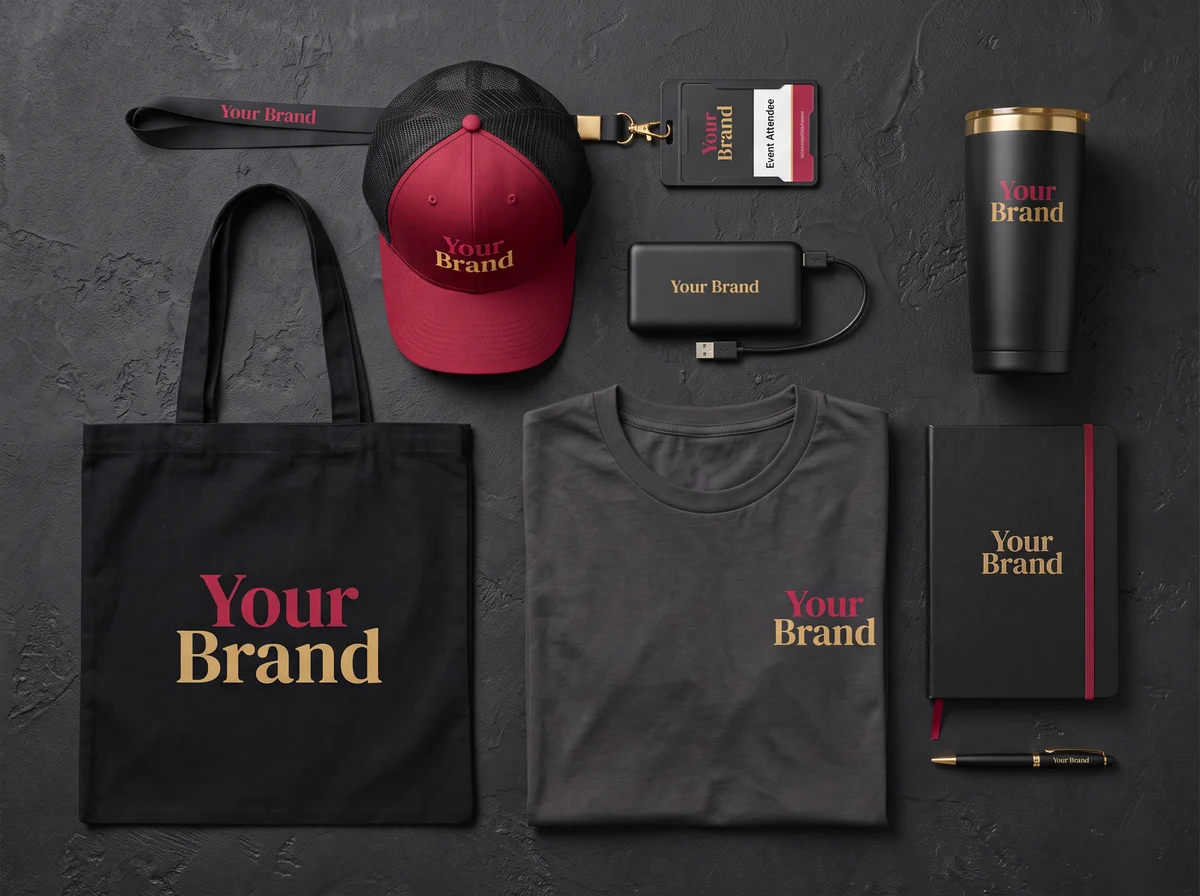
Pens, notebooks and other stationery are still the highest-distribution item in most merchandise programs, and for good reason: they are inexpensive enough to hand out widely and still land on a desk where the branding gets seen repeatedly. The tradeoff is that this category is the easiest to get wrong on quality. A pen that stops writing after a week does more brand damage than not handing one out at all.
For education clients and professional services firms where desk visibility matters, a mid-weight metal pen paired with a branded notebook tends to outperform a bin of giveaway plastic pens by a wide margin, at a modest cost difference per unit.
Branded apparel does double duty: it is a giveaway item and a walking advertisement whenever it is worn outside the office or event. Polos and quarter-zips work well for staff uniforms and trade show teams, while caps and toques are lower-cost options that still get regular wear, especially for outdoor-facing industries like construction and automotive.
The decoration method matters as much as the garment here. Embroidery holds up to washing far better than a printed logo on apparel that gets worn weekly, which is why we default to embroidery for anything meant to last a full season or longer. See our full branded apparel options for sizing and decoration guidance by garment type.
Lanyards, badge holders and booth giveaways are built for a single job: keeping your brand visible for the duration of an event and for the walk back to the parking lot afterward. Lanyards in particular are worth planning ahead of time rather than as an afterthought, since every attendee wearing one becomes a moving reminder of who is exhibiting.
For multi-day conferences or trade shows, pairing a branded lanyard with a small drinkware item at the booth tends to outperform a table of loose giveaway items, since it gives the visitor one thing to actually use during the event instead of several things to lose. Our trade show display guidance covers how to plan booth materials alongside giveaways so the whole presence looks coordinated.
Most merchandise programs end up mixing categories rather than sticking to one, and the mix is usually driven by budget more than preference. A common pattern is to spend more per unit on a smaller run of drinkware or apparel for staff and top clients, while spreading a lower-cost item like pens or lanyards across a much larger list for general visibility. Neither approach is wrong on its own, but the two get confused when a program tries to use one item for both jobs, usually ending in either an overspend on volume or an underwhelming gift for people who were expecting more.
A trade show giveaway, an onboarding kit and a client gift call for different price points and different products. Deciding the occasion first narrows a huge catalogue down to a short list quickly.
Drinkware, apparel and tech accessories are worn or used repeatedly, so a quality issue gets seen repeatedly too. Save the lower-cost items for one-time, high-volume giveaways like trade show swag.
Embroidery for apparel that gets washed regularly, laser engraving for drinkware and desk items, screen printing for one-time event giveaways. The right method extends the life of the branding, not just the product.
Employee recognition programs, onboarding kits and annual trade show inventory all benefit from keeping a record of what was ordered, so a reorder matches the original run instead of starting from scratch. This is where promotional fulfillment and warehousing save the most time for recurring programs.
The categories above cover what performs well broadly, but the right mix depends on your industry, your audience and the occasion. Tell us the use case and budget, and we will put together a curated selection with pricing and timelines from Proforma's supplier network.